Think of the U.S. power grid as a giant machine that grew piece by piece over 140 years. It started in 1882 with Thomas Edison’s first power plant in New York, which used “direct current” (DC) electricity that could only reach homes within a mile. Soon after, Nikola Tesla and George Westinghouse proved that “alternating current” (AC) was much better because it could travel across long distances, winning the “War of the Currents” and setting the standard we still use today.
- November 4, 1879 - Thomas Edison invents the electric light and files patent.
- 1882 - First electricity distribution system built in Lower Manhattan NY.
- June 3, 1889 - The first electric power transmission line in North America operated at 4000 V.
- 1907 - The first three-phase alternating current power transmission at 110 kV took place between Croton and Grand Rapids, Michigan.
- By 1914 - Fifty-five transmission systems operating at more than 70,000 V were in service, and the highest voltage then used was 150 kV.
- By 1930 - Approximately 85% to 90% of urban households in the United States had electricity connected directly to their homes.
- The United States has the second largest electricity sector in the world, with 4,430 Terawatt-hours of generation in 2025.
- Today, the US energy grid is made up of nearly 6,000 large power-generating plants and about 300,000 miles of transmission lines.
- Transmission-level voltages - Usually considered to be 110 kV and above.
- Subtransmission-level voltages = Usually considered 33 kV and 66 kV.
- Distribution-level voltages - Usually considered less than 33 kV.
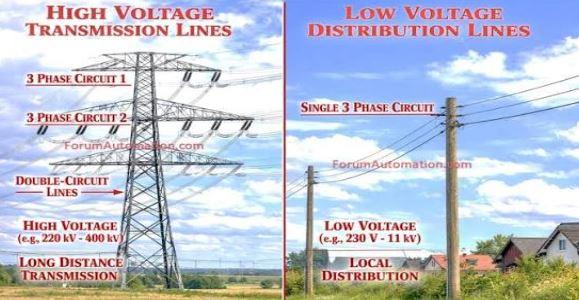
Types Of Power Lines
Next –> Lesson 2 – The Electromagnetic Spectrum