
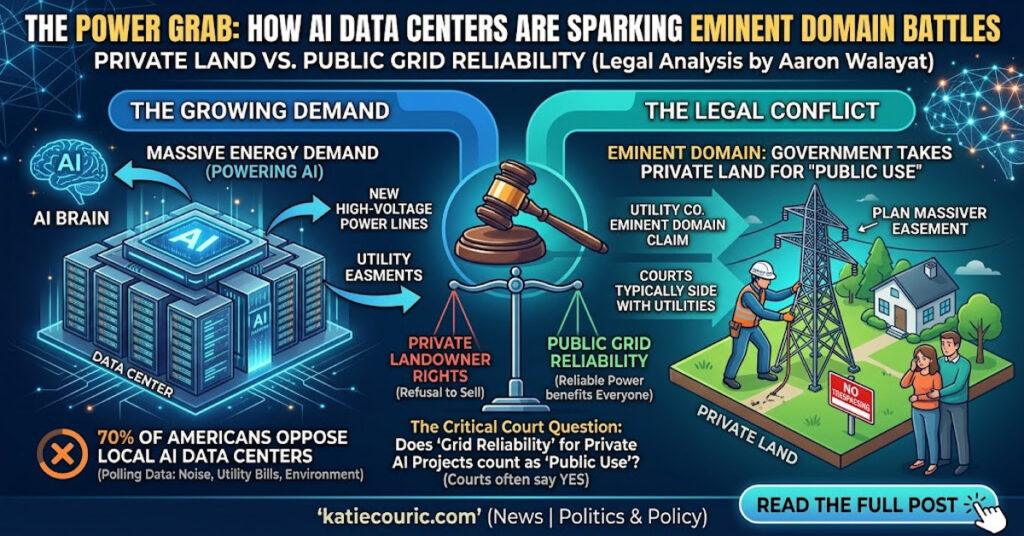
Data centers now consume a significant portion of national electricity, requiring utility companies to build new high-voltage transmission lines across private land. When landowners refuse to sell easements for these power lines, utilities are turning to eminent domain—the legal power allowing governments to seize private land for “public use”. While polling shows that roughly 70 percent of Americans oppose having AI data centers built in their communities due to concerns over high utility bills, noise, and environmental impacts, courts generally side with utility companies. Judges often view adding power lines as a valid public use because maintaining overall grid reliability benefits local consumers.
There’s a growing conflict between private property owners and electric companies trying to power massive AI computer facilities. Because AI requires enormous amounts of electricity, utility companies need to run heavy-duty power lines across people’s yards and property to deliver that energy. If homeowners refuse to sell their land for these power lines, utilities can ask the government to force a sale through a law called eminent domain, which allows property to be taken for the public good. Even though many residents feel it is unfair to lose their land to support private tech projects, utility companies usually win in court by arguing that keeping the electric grid strong and reliable counts as a public benefit for everyone.
Read the full article